Moving into Hainault flats with stairs: safe strategies
Posted on 02/06/2026
Stairs can turn a simple flat move into a proper faff. Boxes feel heavier on the second trip, a sofa suddenly looks wider than the staircase, and you realise very quickly that good intentions are not the same as good logistics. If you are moving into Hainault flats with stairs: safe strategies matter because they protect your back, your belongings, your walls, and your time.
This guide brings together practical planning, safer lifting habits, and local moving know-how for Hainault flats where steps, landings, narrow turns, and awkward parking can make all the difference. Whether you are moving a studio, a family flat, or just the heavy bits and the bits that scratch, the goal is simple: get everything in cleanly, calmly, and without the "oh no" moment halfway up the staircase.
If you want a broader overview of support options, you may also find flat removals in Hainault, man and van help in Hainault, and the services overview useful as you decide how hands-on you want the move to be.
Why Moving into Hainault flats with stairs: safe strategies Matters
Stair-heavy flat moves are not just about fitness. They are about control. One badly timed lift, one box packed with too much weight, one missed measurement, and suddenly the move becomes slower, riskier, and more expensive. To be fair, that is the bit many people underestimate. A few flights of stairs do not sound dramatic until you are carrying a mattress, a fridge-freezer, or a wardrobe up them while trying not to knock the paintwork to pieces.
In Hainault, many flats involve shared entrances, tighter corridors, or staircases where turning space is limited. Some buildings are straightforward, others make you do a bit of mental Tetris before you even touch the first item. Safe strategy matters because the route is part of the move. If you ignore the route, you are guessing. And guessing with heavy furniture is a bad hobby.
Safe moving also matters for neighbours and the building itself. Stairwells, bannisters, and communal walls are vulnerable during a rushed move. Good planning keeps you considerate, avoids complaints, and reduces the chance of damage claims later. If you are comparing professional support, the team pages on removal services in Hainault and furniture removals in Hainault give a useful sense of what experienced help normally covers.
How Moving into Hainault flats with stairs: safe strategies Works
The basic idea is simple: reduce load, plan the route, protect the space, and move with a steady rhythm rather than brute force. In practice, that means you start before moving day. Measure the staircase. Check the width of the narrowest point. Look at the landing turns. Think about where the van will stop, whether parking is realistic, and how far your carry distance will be.
Then you sort items into three buckets: easy, awkward, and specialist. Easy items are boxes of clothes or kitchenware. Awkward items are beds, sofas, mirrors, and desks. Specialist items are pianos, very heavy appliances, or anything that needs unusual handling. If you have bulky or valuable pieces, it is worth reading the guide on why piano moving is best left to professionals and the practical notes on sofa storage and handling before you commit to a DIY lift.
From there, safe moving becomes a sequence rather than a scramble. Pack properly. Label clearly. Protect stair edges where you can. Use the right lifting technique. Keep the route clear. Rest before you get tired, not after. That last bit sounds obvious, but once you are sweating halfway up a staircase, judgement gets a bit fuzzy. Happens to the best of us.
Key Benefits and Practical Advantages
When you use safe moving strategies for stair-access flats, the benefits are practical and immediate. You usually finish faster because fewer mistakes happen. You lower the chance of injury, which is the big one. And you protect your belongings from the kind of knocks that do not always show up right away, like a chipped table edge or a bent bed frame.
There is also a quieter benefit: stress drops. A move can feel loud, crowded, and oddly relentless. Doors banging. Boxes scuffing. Someone asking where the kettle is while you are still trying to get a chest of drawers upstairs. A clear plan helps you stay calm enough to make decent decisions.
- Less lifting strain: good packing and route planning mean less carrying than you think.
- Lower damage risk: walls, banisters, furniture, and flooring stay better protected.
- Smoother teamwork: everyone knows when to lift, pause, or rotate an item.
- Better time control: stair moves usually run longer than ground-floor jobs, so structure matters.
- Less disruption: this matters in shared Hainault blocks, where courtesy counts.
If you are still weighing up whether to do it yourself or bring in help, removal companies in Hainault and man with a van Hainault can help you compare levels of support without overcommitting too early.
Who This Is For and When It Makes Sense
This approach suits anyone moving into a flat with stairs where the route is not perfectly open and furniture is not feather-light. That includes first-time renters, students moving into upper-floor accommodation, couples sharing a one-bedroom place, families downsizing, and anyone who has looked at a sofa and thought, "That is not going up there in one piece without a plan."
It also makes sense if you have time pressure. Same-day or short-notice moves leave less room for error, which is why some people turn to same-day removals in Hainault for a faster reset. If the move is from or near a busy route, local access can matter just as much as the stairs themselves. The article on narrow street moving tips near Hainault Station is especially handy if parking and carry distance are likely to be tight.
There is a point where DIY becomes penny-wise and pound-foolish. If you are moving a piano, a large corner sofa, or a mattress up a narrow staircase with a sharp turn, professional help is often the sensible call. If you want to understand the safer handling side, the guide on kinetic lifting for safer moves is worth a look.
Step-by-Step Guidance
Here is a practical way to handle a stair-based flat move without making it harder than it needs to be.
- Measure first. Check the stair width, landing space, doorway clearances, and any awkward bends. Measure tall items as well as wide ones.
- Map the route. Decide where the van will park, where the first drop point will be, and which item goes in first. The route should feel obvious before moving day starts.
- Declutter before packing. The fewer things you move, the fewer things you carry upstairs. A bit of sorting now saves a lot of breath later. The advice in decluttering before moving fits this stage neatly.
- Pack by weight and fragility. Keep heavy items in smaller boxes. Do not create a brick and call it a box. Your future self will not thank you.
- Protect the building. Use blankets, corner guards, tape, and door protection where appropriate. Keep stairwells clear for residents.
- Break furniture down. Remove legs, shelves, mattress pads, and loose parts. Flat-pack where safe and sensible.
- Use proper lifting technique. Bend at the knees, keep the load close, and avoid twisting on the stairs. If a carry feels unstable, stop and reset.
- Move in a sequence. Send lighter items first if you need to clear space, then bring in the bulky pieces with the route ready.
- Pause and check. Take a breath at landings. Reassess the turn before pushing onward. A ten-second pause can prevent a very annoying scrape.
- Unpack the essentials first. Kettle, bedding, phone chargers, toiletries, and basic tools should be easy to reach when you arrive.
For packing details that make the stair work easier, have a look at packing like a pro for a hassle-free move and the more route-focused heavy object mobility tips.
Expert Tips for Better Results
1. Use smaller boxes for books and kitchen items. Heavy boxes are the classic stair-move trap. A smaller box that is full is still safer than a huge one that looks manageable until you lift it. Truth be told, books are the silent villain of moving day.
2. Assign roles before the move starts. One person leads, one steadies, one opens doors, one watches the landing. Even a simple three-person system reduces awkward pauses and miscommunication.
3. Keep hands free where possible. If you need to open a door, carry a torch, or manage the stairwell, do not overload yourself with extras. Less in the hands means better balance.
4. Check clothing and footwear. Trainers with decent grip are better than smooth soles or loose slippers. Clothes should not catch on bannisters or drag underfoot. Small thing, but it matters.
5. Think about timing. Early morning moves can be calmer and cooler. By late afternoon, tiredness creeps in, and stairs seem to multiply. If you have ever carried a wardrobe after three hours of lifting, you know the feeling.
6. Protect corners twice. If a staircase has a tight turn, protect both the item and the wall. One blanket is often not enough. Double-check, then check again.
7. Keep a light sense of humour. Honestly, it helps. A move is easier to manage when nobody takes every wobble as a catastrophe. Not every bump is a disaster; sometimes it is just a bump. Carry on.
If you are moving appliances or anything that stays in storage for a while, the practical guide on freezer storage best practices can help you avoid silly mistakes at the start and end of the move.
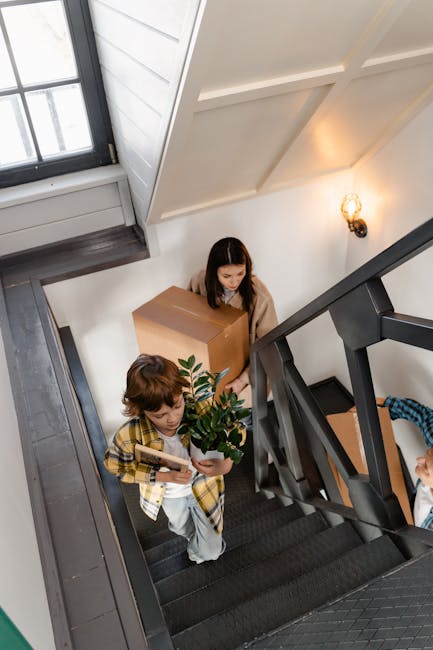
Common Mistakes to Avoid
Most stair-move problems come from rushing, overpacking, or assuming the route will work out on the day. That optimism can be expensive.
- Packing boxes too heavy: especially books, dishes, and tools. If you have to rethink your grip before leaving the room, it is already too much.
- Skipping measurements: sofa arms, bed frames, and wardrobes do not magically shrink at the staircase.
- Forgetting parking and access: a long carry up stairs is much worse when the van cannot stop close by.
- Ignoring sharp turns: the corner is often the hardest part, not the stairs themselves.
- Not protecting surfaces: one scrape on a communal wall can create unnecessary hassle.
- Trying to lift solo when two people are needed: this is where strained backs and dropped furniture happen.
- Leaving essentials mixed in with random boxes: nothing feels more chaotic than searching for a charger at 9 p.m. while surrounded by unopened cartons.
A related mistake is not setting expectations with landlords, neighbours, or building managers where relevant. Even if you are not dealing with formal permissions, a bit of courtesy goes a long way. It keeps the move friendly, which is worth more than it sounds.
Tools, Resources and Recommendations
You do not need fancy equipment for every move, but the right basics make stair work far safer.
| Tool or resource | Why it helps on stair moves | Best used for |
|---|---|---|
| Furniture blankets | Protects walls, banisters, and delicate finishes | Sofas, tables, wardrobes, appliances |
| Gloves with grip | Improves hold and reduces slips | Boxes, frames, and awkward grips |
| Straps or lifting aids | Helps distribute load more evenly | Heavier furniture and appliance handling |
| Labels and marker pens | Makes unpacking and sequencing much easier | Every box, ideally before the move starts |
| Measuring tape | Prevents guesswork with stair and furniture clearances | Large items, turns, and door frames |
For support with packing materials, a good next stop is packing and boxes in Hainault. If you need short-term space while you stage the move, storage in Hainault can give you breathing room, especially when stair access is awkward and you would rather split the move into calmer parts.
And if you are comparing broader support options, removals in Hainault and removal van hire in Hainault are useful pages to review before you decide how much of the job you want handled for you.
Law, Compliance, Standards, or Best Practice
For most flat moves, the practical focus is safety and reasonable care rather than complex legal procedure. In the UK, the sensible baseline is to avoid putting yourself or others at unnecessary risk, protect shared spaces, and make sure moving methods are proportionate to the weight and size of the item being handled.
That means a few straightforward best practices. Use suitable lifting methods. Do not obstruct communal stairs for longer than needed. Keep emergency routes clear. If a building has its own move-in rules, follow them. If parking is tight or access affects neighbours, plan around it rather than hoping nobody minds. They usually do mind. A bit.
If you are hiring help, check that they are clear about insurance, handling practices, and what is included. Reading the site information on insurance and safety, health and safety policy, and terms and conditions is a sensible part of due diligence, especially for heavier or higher-risk moves.
For everyday moves, the standard to aim for is simple: careful handling, clear communication, appropriate equipment, and no rushed shortcuts. That is the real benchmark. Not flashy, just solid.
Options, Methods, or Comparison Table
If you are deciding how to approach stairs in a Hainault flat move, the most common options are DIY, mixed help, or full support. Each has a place, depending on the items, the staircase, and your tolerance for stress.
| Approach | Best for | Pros | Trade-offs |
|---|---|---|---|
| DIY move | Small loads, light furniture, short stair runs | Lower direct cost, full control | Higher physical effort, more chance of damage if rushed |
| Mixed help | Medium-sized flat moves with a few heavy pieces | Flexible, cost-conscious, safer than solo lifting | Needs coordination and clear roles |
| Professional support | Heavy furniture, awkward staircases, tight access, time pressure | Better handling, less strain, often smoother on the day | Higher upfront spend, but often worth it for tricky moves |
For students or smaller households, a lighter approach may be enough, especially if you are only taking a few pieces. The page on student removals in Hainault can be helpful if you are moving into a modest flat with a narrow staircase and not much furniture to begin with.
Case Study or Real-World Example
Imagine a couple moving into a second-floor flat in Hainault on a wet Friday evening. The staircase is clean but narrow, with a turn halfway up and a small landing near the top. They have two large suitcases, six boxes, a bed frame, a mattress, and a sofa that looks reasonable in the living room but considerably less reasonable near the stairs.
They start well: boxes are labelled, the bed is dismantled, and the mattress is wrapped. They park as close as possible without blocking access, which saves about ten minutes of carrying per round trip. But here is the bit that makes the difference: they do not try to move the sofa first. They clear the route, protect the wall at the turn, and bring up lighter items before tackling the awkward piece with a second set of hands.
That small decision changes the whole move. The stairs stay intact, the sofa gets in without a scrape, and the evening ends with the kettle unpacked rather than a crisis over a bent armrest. It is not glamorous, obviously. But it works.
If they had needed a bit more support for the heavier items, a page like bed and mattress relocation tips would have been ideal before the move, while the house cleaning checklist for movers would have helped them leave the old place in decent shape after the last box was out.
Practical Checklist
Use this before moving day. It keeps the job grounded and stops small oversights becoming big ones.
- Measure stair width, landings, and door frames.
- Check parking and the shortest safe carry route.
- Sort items into light, heavy, fragile, and specialist categories.
- Disassemble furniture where possible.
- Pack heavy items into smaller boxes.
- Label boxes clearly by room and priority.
- Set aside essentials for the first night.
- Protect walls, corners, and bannisters.
- Wear practical shoes and comfortable clothes.
- Use two people for bulky or awkward items.
- Keep pathways, stairs, and exits clear.
- Take breaks before fatigue turns into sloppy lifting.
- Confirm insurance and safety details if you are hiring help.
- Plan unpacking in stages, not all at once.
For a calmer overall move, it can also help to read stress-free moving strategies and the guide to essential moving-day checklist tips for Hainault IG6. That combination gives you both the practical route planning and the broader day-of structure.
Conclusion
Moving into a flat with stairs is rarely hard for one single reason. It is usually a chain of small pressures: the carrying, the turning, the parking, the timing, the fatigue. The good news is that each of those pressures can be reduced with the right approach. Measure first. Pack sensibly. Use proper lifting. Protect the building. Ask for help when the job deserves it.
That is the heart of Moving into Hainault flats with stairs: safe strategies. Not perfection. Just a safer, calmer move that gets you through the staircase without drama. And honestly, that is a pretty good outcome. You'll notice the difference almost immediately once the first heavy item makes it up cleanly.
Get a free quote today and see how much you can save.
If you are still weighing up your options, it may help to explore the wider about us page and the pricing and quotes information so you can move forward with a clearer picture. A well-planned move really does feel better. Even the stairs.